DIRECT METHOD
The direct method of teaching was
developed around 1900 in Germany and France. It is sometimes called the
natural method because the aim is to teach students in a similar way
that they acquire their first language.
The
direct method of teaching came as a response to the shortfalls of the
grammar-translation method, which works to teach grammar and translate
vocabulary from the native language of the student.
Therefore,
the grammar-translation method relies heavily on the written language,
whereas the direct method places the emphasis on both listening and
speaking.
Although the direct method
isn’t limited to teaching foreign language, it is however, often used
for this purpose. In fact, you can see evidence of it being used in many
English classrooms around the world today. The aim of this method for
teaching English is to immerse the students in English, the teacher
would use reality, visual aids and demonstrations to teach English to
students.
The teacher would in this
instance focus on repetitive patterns of teaching with grammar being
taught inductively. This means that the rules of grammar are not taught
directly, instead students would learn to change different parts of the
sentence. For example, “I go to school”, the word go could be changed for other verbs like walk, run, jog, drive, etc.
Methodology
The direct method of learning English is fairly simple. In consists, primarily, of just five parts.- Show – The student is shown something so that they understand the word. For example, they might be shown reality or other visual aids such as flash cards for nouns. The teacher might use gestures to explain verbs, and so on.
- Say – The teacher verbally presents the word or sentence, taking care to pronounce the word correctly.
- Try – The student then tries to repeat what the teacher is saying.
- Mould – The teacher corrects the students and ensures that they are pronouncing words correctly.
- Repeat – Finally, the students repeat the word a number of times. Here the teacher uses a number of methods for repetition, including group repetition, single student repetition and other activities designed to get the students to repeat the word.

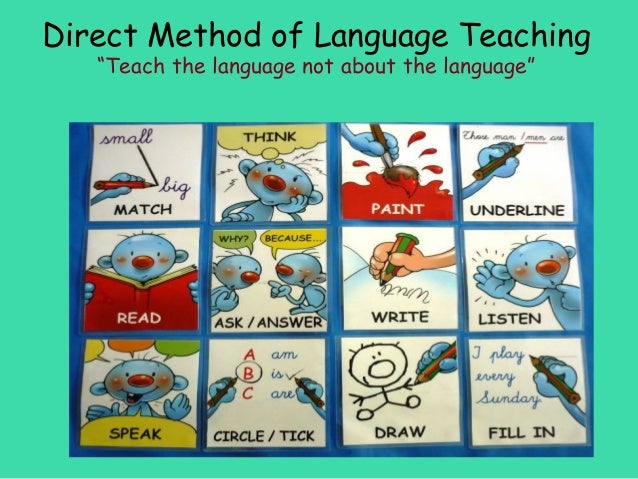
Specific
teaching methods would include such things such as students reading out
aloud, question and answer exercises, conversation practices,
dictation, fill-in-the-blank exercises, amongst others.
Advantages
Probably
the biggest advantage of this method of teaching English is that it
actually teaches the language and doesn’t teach about the language.
Furthermore, due to its emphasis on speech, it is better for students
who have a need of real communication in English. Finally, this method
introduced the use of teaching vocabulary using reality, which is still
widely used today when teaching English to speakers of other languages.
Disadvantages
One
major disadvantage for this method is that is works on the assumption
that a second language is learnt exactly the same way as the first.
Second language acquisition varies considerably from first language
acquisition.
Another criticism of the
direct method is that it was hard for public schools to integrate it.
In his book, R. Brown (1994:56) explains that the direct method wasn’t
successful in public schools because of “constraints of budget,
classroom size, time, and teacher background (native speakers or native
like fluency) made such a method difficult to use.”
Direct Method of Teaching English
Although
parts of this method are still used today, it was largely been
overtaken by the audio-lingual method where the focus wasn’t vocabulary,
instead students were drilled in the use of English grammar. This
audio-lingual method is no longer a popular method of teaching, instead
more communicative methods are more widely used today. Lessons now try
to mimic real, everyday, occurrences, for example, a class would usually
be taught things like ‘asking for things’ in different social settings.
PICTURE


Video
Please view in this URL:
References

Tidak ada komentar:
Posting Komentar